
Building the Infrastructure for Biotechnology Breakthroughs: University of Virginia’s Paul and Diane
COAA-VA Chapter Members Recently Toured the Project
Authors: Matt Kidwell, Project Executive, Skanska & Mashal Hartman, Project Director, UVA
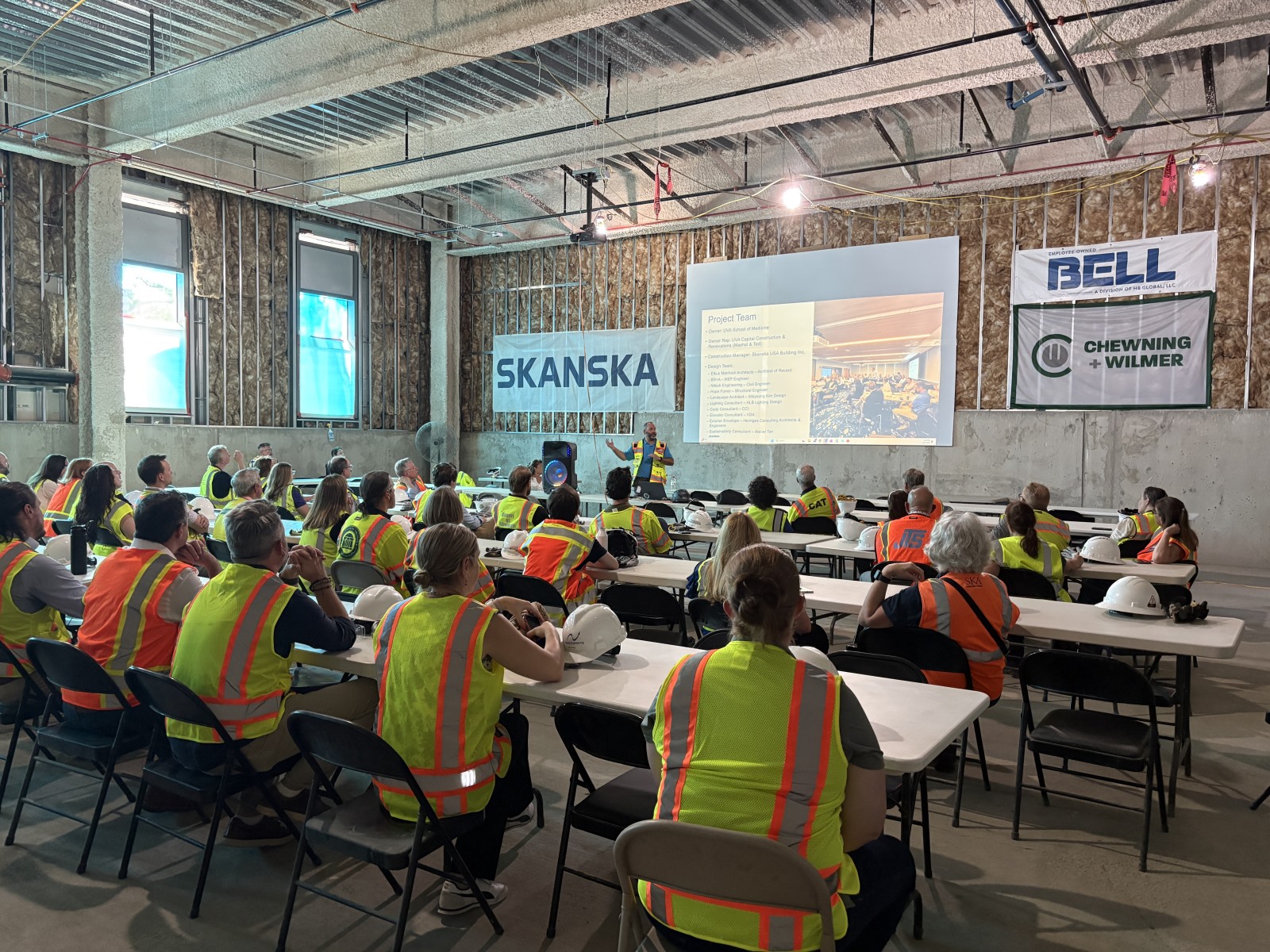
In today’s competitive higher education landscape, universities are investing heavily to distinguish themselves. At the University of Virginia, construction continues on the Paul and Diane Manning Institute of Biotechnology, a 354,809-square-foot, $380 million facility that will advance groundbreaking medical research.
Members of COAA's Virginia Chapter recently toured the Manning Institute. What follows is an overview of how the project team planned for flexibility from the outset to ensure the facility keeps pace with the fast-evolving demands of the biotech industry.
Schematic design for the Manning Institute started in June of 2023, with construction starting six months later. Speed to research while building the largest possible facility is the number one priority. The project utilized a construction management at risk project delivery method and concurrent design-and-construction approach to meet the urgent demand for the sophisticated research facility. The University, Skanska, and Elkus Manfredi Architects maintained constant communication throughout the process to ensure that building flexibility and programming was achieved through the structural steel top out, the exterior skin, and the interior MEP rough-ins – all prior to the full final building design. Early work packages – including site work, utilities, long lead (major) MEP equipment, structure, envelope, long lead (minor) MEP equipment, and interior partitions – were all underway before the project’s design was finalized.
As COVID-related supply issues eased, data center construction across the Northeast began saturating the regional MEP subcontractor market, driving prices up and lengthening timelines for complex projects like lab buildings. Recognizing this risk, UVA had Skanska aggressively pursue key subs (MEP, curtainwall, steel, concrete) and early bid packages – locking in qualified labor and starting construction in late 2023 instead of late 2025.
In response to known budget constraints at the outset and knowing it would never be less expensive to build the size and complexity of building needed, UVA decided to build the entire core and shell, but only fit out half the building for day one. Furthermore, UVA decided to complete the full design of the building upfront to ensure no scope gaps between day one and future fit-out. Major infrastructure, which is typically handled in later phase buildouts, was installed upfront to avoid costly and disruptive rework in the future when fitting out shell spaces, particularly to avoid disrupting completed and occupied lab space. This approach provides immediate space for cutting-edge research with infrastructure in place for a future fit out. Mechanical systems, utility routing, and electrical capacity were similarly planned with future laboratory conversions in mind.
Every detail was decided as a team, balancing the schedule, budget, and future growth. Decisions that might seem inconsequential, such as locating labs in prime view within the building, were intentional. This puts research front and center with the goal of attracting top-tier researchers, attention, and funding for future fit-out.
As of June, the project had logged more than 617,925 construction hours, but significant work remains. After substantial completion, the team still needs to commission, test, and calibrate building systems to ensure optimal performance. The final step, lab activation, will bring the spaces fully online and ready for research in Q2 2028.
When complete, the facility will house state-of-the-art flexible, dense laboratory space with expanded research capabilities. The Institute will play a pivotal role in local, regional, and state bio innovation, centered on research, development, and manufacturing of new cellular, gene, and immunotherapies. The goal is to move from research to patients as soon as possible, condensing the previously standard long, drawn-out trial and approval processes. The Institute is also serving as a seed facility to significantly expand Virginia’s role in the national biotechnology sector.
By The Numbers Box:
- Approximately 2200 people have worked on the project to date, including stakeholders across UVA, Architects, Engineers, third party consultants, and construction workers.
- 12,290 cubic yards of structural concrete poured
- 3,739 tons of structural steel erected
- 717,583 pounds of ductwork installed
- 96 miles of electrical conduit installed
- Approximately 350 workers per day on site
- Zero Lost Time Incidents on the project to date